
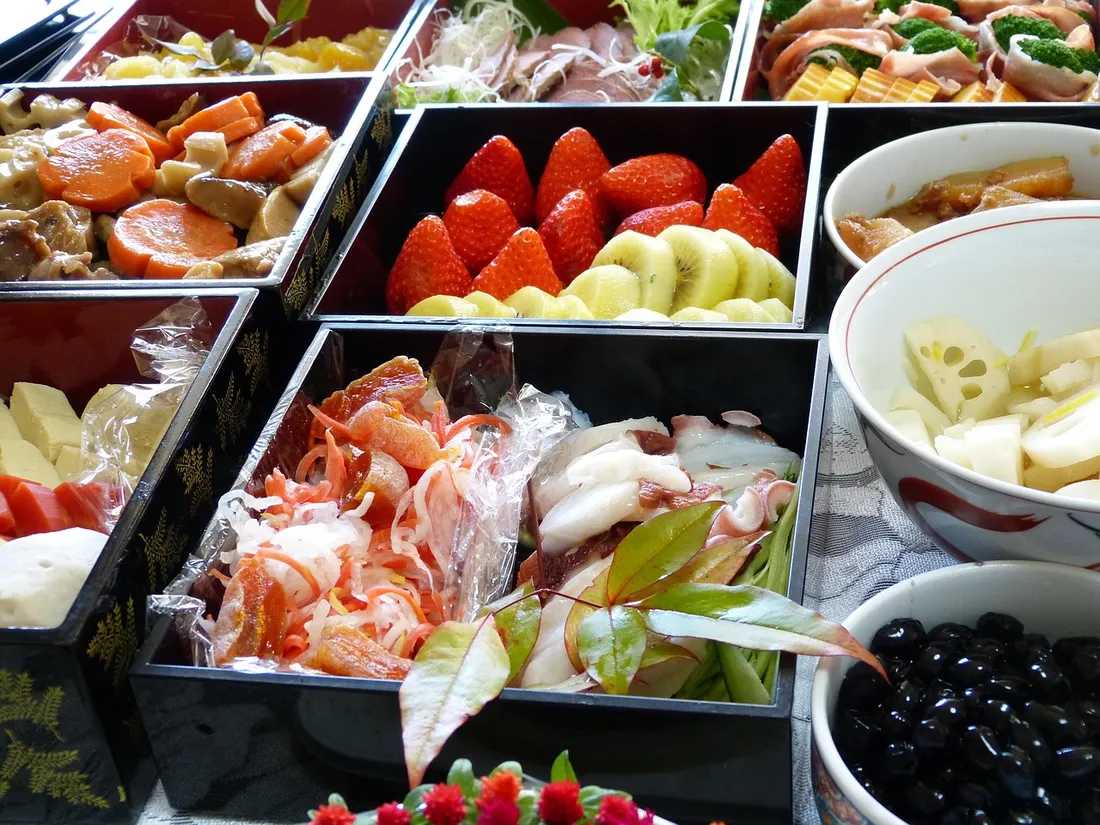
Osechi: the celebratory food that welcomes the year deity
Osechi ryori is the celebratory food for welcoming the toshigami-sama, the deity who brings the new year's fortune. The word comes from "osechiku," food once offered to the gods at each seasonal turning point (sekku); over time "osechi" came to mean only the food of the most important turning point of all - the new year.
There is a reason the dishes keep well. From the ideas that "you don't bustle in the kitchen while the deity is being welcomed" and "the hearth god should rest too," long-keeping dishes came to be prepared at year-end. It is also a practical wisdom: the person who runs the household gets to rest, at least over the new year.
The spelling "osechi ryori" refers to the same thing.
Why tiered boxes, and what goes in each tier
Osechi is packed in tiered boxes to "stack up happiness." The formal form is four tiers, and the fourth is called the "yo-no-ju" to avoid "four" (which evokes death).
| Tier | What goes in |
|---|---|
| 1st tier | Celebration dishes & appetisers (black soybeans, herring roe, candied sardines, fish cake, datemaki, chestnut kinton) |
| 2nd tier | Grilled dishes (prawn, sea bream, yellowtail and other seafood) |
| 3rd tier | Vinegared dishes (red-and-white namasu, vinegared lotus root) |
| Yo-no-ju | Simmered dishes (chikuzen-ni, nishime and other vegetables) |
Arrangements vary by region and household. Today, three- or two-tier sets are the norm.
What the dishes mean
| Dish | The wish it carries |
|---|---|
| Black soybeans | Health and diligence: to "work hard and live well" (mame = diligent/healthy) |
| Herring roe | Fertility and many descendants, from the countless eggs |
| Candied sardines | Bountiful harvest, from sardines once used as rice-field fertiliser |
| Pounded burdock | Family stability, from burdock's deep roots |
| Red-and-white fish cake | The half-round shape suggests the first sunrise; red wards off evil, white for purity |
| Datemaki | Scholarly success, its shape recalling a scroll (book) |
| Chestnut kinton | Wealth, from its golden colour ("kinton" = golden mash) |
| Rolled kelp | A pun on "yorokobu" (to be glad); also a wish for long life |
| Prawn | Longevity, symbolised by the bent back and long whiskers |
| Sea bream (tai) | A pun on "medetai" (auspicious); the celebratory fish |
| Yellowtail | Career success, from a fish that is renamed as it grows |
| Lotus root | A clear view of the future, seen through its holes |
| Taro / yatsugashira | Many descendants, from the many child-tubers it grows |
| Red-and-white namasu | A wish for peace, evoking the red-and-white ceremonial cord |
The three celebration dishes
The basic three, said to let you "celebrate the new year if you have just these": in Kanto, black soybeans, herring roe and candied sardines; in Kansai, black soybeans, herring roe and pounded burdock - another regional difference.
When is osechi eaten?
Nationwide, it is generally eaten on the morning of January 1, with the family, using celebration chopsticks. But in parts of Hokkaido and Tohoku, the custom is to start eating osechi on New Year's Eve, from an old sense that a new day begins at sundown. Neither is more "correct."
Ozoni, eaten alongside osechi, has even greater regional variety - see Ozoni: Regional Styles & Recipes. To buy rather than make it, see Osechi Delivery Comparison.
PR — This page contains promotional content
Frequently asked questions
What does osechi mean?
It is an offering to the year deity who brings new year fortune, a celebratory food carrying wishes for family health and prosperity. The word comes from "osechiku," food offered to the gods at seasonal turning points.
Why are so many dishes long-keeping?
From the ideas that kitchen work is avoided during the first three days while the deity is welcomed, and that the hearth god rests too, long-keeping dishes came to be made at year-end.
What do black soybeans mean?
A wish for health and diligence - to "work hard and live well." They are one of the three celebration dishes and essential to osechi.
Why call the fourth tier "yo-no-ju"?
Because "four" evokes "death," an unlucky number, so the character "yo" is substituted for good fortune.
Is osechi eaten on January 1 or New Year's Eve?
Nationwide, the morning of January 1 is usual, but parts of Hokkaido and Tohoku start on New Year's Eve. Neither is more correct.